


The 19th Commemoration of the genocide in Viborg town centre in northern Jutland, Denmark
April 6, 2019
On the 7th April 2013 at Viborg the 19th commemoration of the genocide that was perpetuated against the Tutsi was held in Viborg town centre in northern Jutland, Denmark. The address of where this commemoration was held was Vesterbro grade 1, 8000 Viborg.
The master of ceremony Mr. Danis Kabengera welcomed the guests and outlined the agenda of the day and requested everyone to rise up for a 1 minute of silence in honoring our people that were killed in genocide against Tutsi. Prayers both in Kinyarwanda and Danish were conducted respectively, which were followed by a walk to remember march that begun from the Vesterbro gate 1 through BoJensens gate through Skjorrtensborg then Sankt Hans gate to Gravene and back to Vesterbrogade. This route was through Viborg Town Center that was approximately 3 Km. Along this road leaflets we were able to hand out both in English and Danish written texts explaining the purpose of the march.
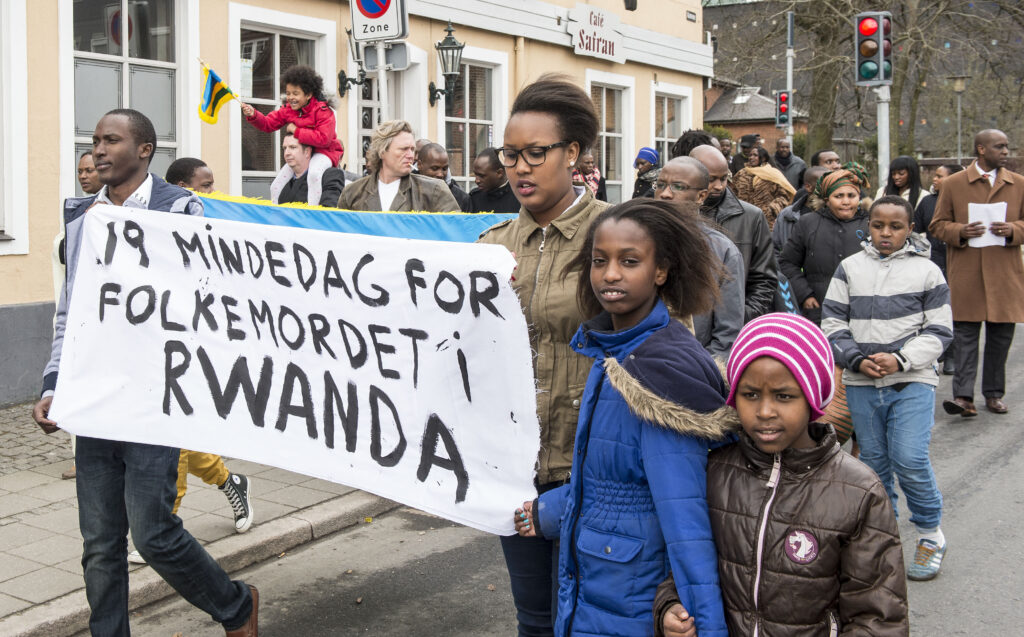
Foto by Peter Eilertsen
After a short break, tea and coffee were served and the program continued with the listening to Mr. Kizito’s song Twanze gutoberwa amateka. Then officially the main guests were introduced to the Rwandan community in Jutland and Fyn. And one of the guests Madam Illumine was called upon to read her poem, highlighting the loss of her mother that symbolizes every ones mother that was killed in the genocide against the Tutsi. One of the main speaker Mr. Hans Henrik Lund was called upon to give his testimony and he said the following
Director Hans Henrik testimony:
We are gathered in Denmark on the 7th April at the same time there are thousands of people that are gathered at Amahoro Stadium in Rwanda.
Genocide has taken places in several places in the world, both in Asia, Europe, America and Africa. The worst genocide took place in Europe during 2nd World war, and the last genocide also took place in Europe during Kosovo conflict.
Genocide is a crime against humanity and we expect the world institutions to act immediately. Unfortunately they did not do that in Rwanda where more than 1 million Tutsis were killed.
It is important to gather continuously for commemorate the genocide of Tutsi in Rwanda. It is important to gather as the Rwandan Diaspora living in many countries with the purpose not to forget and to tell the children and youth about their roots and history.
Jackline Hansen, Chairperson for the Diaspora group in Jutland, Denmark is one of those responsible persons eager to do this.
It is important that those involved in the genocide should be held accountable in international courts for their crimes. Criminal cases never cease and righteousness has to be fulfilled.
At the same time we all need to forgive those who confess and we are obliged to live in peace and reconcile with everybody.
We have to be aware of any symptoms of any future conflicts.
May God bless Rwanda and give peace and prosperity for the country in the future.
Chair Person’s Speech of 07.04.2013
This date of 07/04/ of every year officially all Rwandan begins to commemorate the genocide against Tutsi that was perpetuated in 1994. And these activities continue in all districts of Rwanda that last a hundred days. At all our memorial sites in Rwanda the commemoration officially has begun. Around the world Rwandans are also commemorating. Our compatriots in Zealand will commemorate on 13th of April 2013 in Copenhagen which will be next Saturday all those that will manage to join them on that day will be greatly appreciated.
We are here gathered to remember on this 19th commemoration of genocide committed against Tutsi in 1994, where over a million people were killed in a hundred days. The genocide that was perpetuated against the Tutsi was not a common criminal act, the Tutsi genocide was not done in hiding, it was done in the broad daylight whereby all the nations of the world were watching! The UN that was supposed to keep law and order, turned into being spectators of this genocide. The International Community promised us “never again”! That genocide will never take place again. Let us remind the International Community of what are they doing now regarding this promise of never again. The genocide that was perpetuated against the Tutsi was not a common criminal act, and we will never forget our fallen people. There is a lot that remind us of them. Trauma, justice, and those that are negating genocide that was committed against Tutsi.
Let us accept genocide that was perpetuated against Tutsi in 1994. Let us continue to fight against those that are negating this genocide against Tutsi, whether they are Rwandans like us or foreigners. We are all obliged to defend it. The theme of 19th commemoration of the Tutsi genocide is “LET US COMMEMORATE THE GENOCIDE AGAINST TUTSI BY STRIVING FOR SELF RELIANCE”.
Allow me to take you back a bit. I believe almost all of us, we know and understand our bad history legacy of former bad leadership. It encouraged tribalism, nepotism, leading by a dictatorship. This tribalism is what is partly attributed to the Tutsi genocide that took place. In reality the 1994 Tutsi genocide was preceded by some evil acts in 1959. In 1959/1962 my own mother tells us that she was on the list of those Tutsi that were supposed to be killed, it is amazing that the list began a long time ago especially between 1973/1974 Tutsi were killed. In 1992 president Habyarimana killed the Bagogwe Tutsis, until the final genocide of Tutsi was perpetuated in 1994 with the intention of not leaving behind a potential survivor to tell this tragedy. But the Almighty God did not allow it! Through this tragedy there has been a great revival of force that is building our nation and the International Community do not comprehend it.
Ladies and gentlemen and friends of Rwanda you know very well that capital punishment do not exist anymore in Rwanda it was not easy. Gacaca courts also did a very good job that was very difficult. Unity and reconciliation was not also easy, this indicates that survivors say we cannot forget genocide and its side effects, but today we have to live, we have to be strong. Indeed it was not easy, but the result of this is self-evident.
Let us commemorate the genocide against Tutsi, by striving for self-reliance. The way how our nation was destroyed and today, it is part of the fast developing nations. The survivors refused to be victims and they strived for self-reliant. These demand top down discipline when the leaders of a nation have discipline those they are leading they also develop discipline. To elaborate on this discipline allow me to say the following: the person that have this discipline of ability to think analytically, critical to evaluate, understand the truth, persuasive with logic and reasoning while expressing oneself, concentrate, can respond with accuracy. Can select, can plan, and can govern by sense of responsibility hence balancing in his life, a balance by control, hence the discipline person rises. By these points above we can say that Rwanda is balanced and we saw this when international community wrongly pressured us, denying us aid etc. Let us unite basing on the good example of this discipline that Rwanda has shown working hard for self-sustenance. It is not the government of Rwanda alone, that has got the mandate to fight against the genocide ideology and fight those negating the genocide perpetuated against the Tutsi, but all of us have got this mandate to fight for justice. Ladies and gentlemen friends of Rwanda let us remind the nations we are living in that all those suspects of perpetuating the Tutsi genocide of 1994 are supposed to be judged in Rwandan courts or in international courts respectively. Then let us together work hard for our self-sustenance. Let the Almighty God continue to strengthen your hearts.
The master of the ceremony Mr. Kabengera summarized the function of this 19th commemoration by thanking all those that attended. Telling them the importance of commemoration, since to him he was in the midst of genocide in 1994, when he was only 12 years old.
It was not easy and after the genocide against the Tutsi it was not easy to grow up as a survivor at that young age of only 12 years. But he managed to carry on and indeed those who killed his own family, he managed to meet them in prison to see if at all they were remorseful, but what surprised him indeed some of the prisoners say that they were regretting of what they did. While other told him point blank that they regret that he escaped death saying that they wished they would have killed him too.
He closed by stating that let all of us be near the survivors of the genocide against Tutsi 1994, by talking to them, visiting them and indeed encouraging them to continue being strong during this period of remembering our fallen ones.
At 17 hours, the events of the 19th commemorating of genocide against Tutsi were concluded.